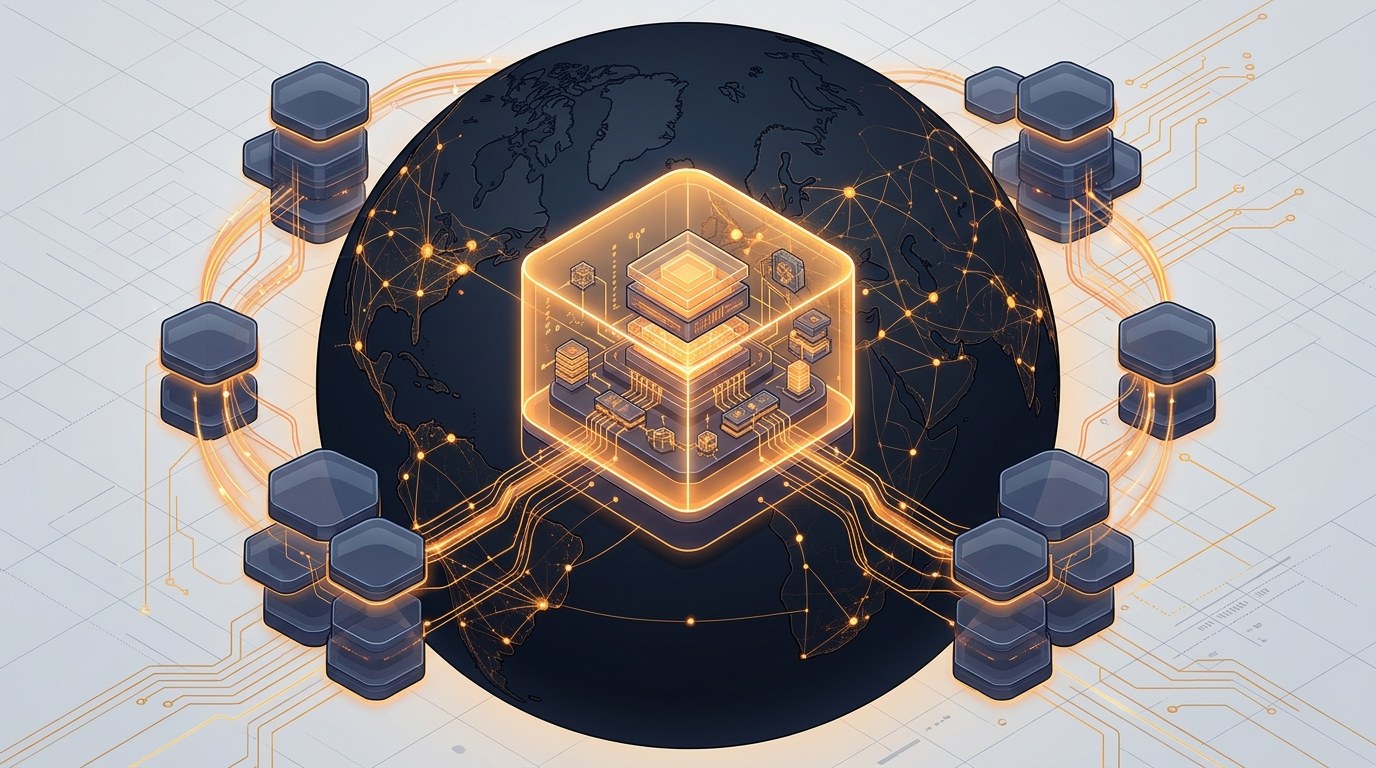
1. The Stateful Edge Shift: One Durable Object Per Agent
Traditional stateless serverless functions forget everything between HTTP calls, forcing teams to stitch together Redis, Postgres, queues, and WebSocket brokers. Cloudflare’s Agents SDK (agents) flips the model: each agent instance is a single-threaded Durable Object with its own embedded SQLite database, hibernatable WebSockets, and alarm scheduler running close to the user.
End-to-End Request & State Lifecycle at the Edge
When a user or webhook targets an agent by name (e.g., tenant-42-analyst), Cloudflare routes the request to that exact Durable Object anywhere on the network. The agent reads local SQLite in microseconds, calls models via AI Gateway, and spins up an isolated Container Sandbox only when untrusted code execution is required:
SQLite runs inside the same process boundary as your Durable Object. Queries execute synchronously with zero network round-trips and survive evictions automatically.
Durable Objects hibernate open WebSockets and Workflows sleep on step.waitForEvent() without charging wall-clock compute while waiting for humans or webhooks.
Run lightweight JS/TS agent logic in V8 isolates (or Dynamic Workers) in milliseconds, and attach a Linux container via ctx.container only when POSIX tools are needed.
ctx.container (Sep 2026), and @cloudflare/workers-oauth-provider v1.x (Oct 2026) standardized OAuth 2.1 for remote MCP servers—making Cloudflare a complete single-vendor runtime for production AI agents.
2. Cloudflare AI Primitive Decision Matrix
Cloudflare’s AI stack is modular: each primitive solves one durability, inference, retrieval, or isolation boundary cleanly. Use this matrix to map every agent workload to its exact primitive without overpaying for idle compute.
| Primitive | Best-Fit Workload | State & Execution Model | Pricing & Free Tier | Avoid Using For |
|---|---|---|---|---|
Agents SDKagents + DO |
Per-user/room stateful agents, live chat, UI state sync, MCP servers, crons. | Single-threaded DO; embedded SQLite, hibernatable WS, schedule(), runFiber(). |
DO Free tier; Paid bills requests + active duration + SQLite. | Heavy video encoding or multi-GB ML training. |
WorkflowsWorkflowEntrypoint |
Multi-step pipelines: doc ingest, fan-out, retries, multi-day human approvals. | Step-checkpointed (step.do, sleep, waitForEvent); survives deploys. |
Active CPU only ($0 sleeping); Free ~3M req/mo. | Sub-50ms live WS streaming to browsers. |
Workers AIenv.AI.run() |
Fast serverless open models (50+ LLMs, embeddings, vision, Llama Guard). | Stateless GPU inference via binding, OpenAI REST, or AI Gateway. | 10k Neurons/day free; $0.011 / 1k Neurons paid. | Frontier reasoning needing Claude/GPT/Gemini. |
| AI Gateway Control Plane |
Proxy for Workers AI + 24+ LLMs: caching, fallbacks, rate limits, DLP. | Universal OpenAI/Anthropic REST & dynamic/<route>; zero-deploy swaps. |
Core routing/cache free; Unified Billing +5% credit fee. | Custom stateful app logic (keep in Worker/DO). |
| Vectorize & AI Search | Vectorize: custom RAG. AI Search (ex-AutoRAG): managed R2 RAG + MCP. | Global vector index or turnkey R2-to-index continuous re-indexing. | Usage-based queried dimensions & stored vectors. | Transactional chat ledgers (use DO SQLite). |
Container Sandboxesctx.container |
Untrusted Python, Node, Bash, Git repos, compilers requiring full Linux. | DO owns Linux container via ctx.container; runtime image, beta snapshots. |
Workers Paid; active vCPU, RAM, disk & snapshots. | Pure JS/TS transforms (use Dynamic Workers). |
| Dynamic Workers Isolates |
AI-generated JS/TS “Code Mode” tools with 100x faster cold starts. | Ephemeral V8 isolates with strict capability bindings, zero host access. | Workers compute pricing; ~ms startup overhead. | Native C/Python binaries or apt packages. |
Composition Patterns That Win in Production
Keep the user’s live WebSocket in an Agent DO for <50ms streaming and state sync. Spawn a Workflow for multi-minute audits or retries and push updates back to the Agent via RPC.
ctx.container SandboxYour Agent DO holds conversation memory in SQLite and starts its attached Linux container via this.ctx.container, snapshotting disk state before sleeping to preserve Git checkouts.
this.ctx.container + Sandbox SDK 1.0 utilities. Legacy Container / Sandbox classes receive updates only through Dec 31, 2026.
3. Annotated Workspace Tour: Wrangler Dev, DO SQLite & AI Gateway
Developing edge agents locally mirrors production: wrangler dev runs your Worker, Durable Object SQLite database, and hibernatable WebSockets in Miniflare while forwarding model calls through your live AI Gateway for real-time cost, cache, and guardrail telemetry.
Swipe horizontally to view the full interactive workspace mockup
| table | rows | latest entry |
|---|---|---|
| cf_agents_state | 1 | {"status":"awaiting_approval"} |
| cf_agents_schedules | 2 | heartbeat_cron (next: 00:00Z) |
| tool_audit_log | 48 | sandbox.exec("pytest") → 0 |
in 14m 20s • Stashed fiber: pr-review-88 (human-in-loop)anthropic/claude-sonnet-4-5 (BYOK)openai/gpt-5.2 (Unified)workers-ai/@cf/meta/llama-3.3-70b60 req/min per tenant • Sink: Workers Logs + Logpush7 Controls Every Edge Agent Engineer Must Master
npx wrangler types after every wrangler.jsonc edit to regenerate strict TypeScript bindings for DOs, AI, R2, and Containers.wrangler dev boots real SQLite-backed Durable Objects locally, letting you test WebSockets, alarms, and RPC calls offline before deploying.cf_agents_state (auto-managed by setState), cf_agents_schedules, and custom tables directly inside .wrangler/state/v3/do.runFiber() tasks so evictions never drop work.dynamic/<route> without redeploying your Worker code.4. Embedded SQLite, Hibernatable WebSockets & Durable Scheduling
Subclassing Agent<Env, State> from the agents package turns a Cloudflare Durable Object into a persistent, real-time agent runtime with four built-in durability primitives—requiring zero external databases or message brokers.

this.sql & this.setState) sit directly inside the isolate, surrounded by hibernatable WebSocket channels and a SQLite-backed cron/alarm scheduler.
setState() + this.sqlCall this.setState(next) to atomically write JSON state to cf_agents_state and broadcast a cf_agent_state sync frame to all connected React/JS clients. Use tagged-template this.sql`...` for relational audit logs, message histories, and tool ledgers.
useAgentWebSockets stay open at the Cloudflare edge even when the DO hibernates to zero memory. Store per-socket metadata with connection.setState(); the official React useAgent() hook auto-reconnects and syncs state bi-directionally.
this.schedule()Schedule delayed seconds (60), exact Date timestamps, or cron strings ("0 * * * *"). The SDK stores jobs in SQLite and multiplexes them onto the DO’s single alarm so independent schedules never overwrite each other.
Wrap critical active work in keepAliveWhile() to prevent mid-call eviction, or use runFiber() + stash() to checkpoint long multi-turn runs and pause for human approval at $0 idle cost.
import { Agent, routeAgentRequest } from "agents";

interface OpsState { pendingApproval: string | null; runs: number; }

export class OpsAgent extends Agent<Env, OpsState> {
  initialState: OpsState = { pendingApproval: null, runs: 0 };

  async onStart() {
    this.sql`CREATE TABLE IF NOT EXISTS audit (id TEXT PRIMARY KEY, action TEXT, ts INTEGER)`;
    await this.schedule("0 * * * *", "hourlyDigest", { channel: "ops" }); // SQLite-backed cron
  }

  async requestDeploy(releaseId: string) {
    this.sql`INSERT INTO audit (id, action, ts) VALUES (${crypto.randomUUID()}, ${releaseId}, ${Date.now()})`;
    this.setState({ ...this.state, pendingApproval: releaseId }); // Persists & pushes over WS
  }

  async hourlyDigest(payload: { channel: string }) { /* wakes DO via alarm, runs, then hibernates */ }
}

export default { fetch: (req: Request, env: Env) => routeAgentRequest(req, env) };
5. Remote MCP Servers with McpAgent & OAuth 2.1
Cloudflare is a primary edge host for remote Model Context Protocol (MCP) servers over Streamable HTTP (/mcp). By pairing a Durable Object MCP server with @cloudflare/workers-oauth-provider v1.x (MCP 2026-07-28 spec), any client—Claude, Cursor, Windsurf, or another Agent—can authenticate with GitHub, Google, or Cloudflare Access and call your tools globally.
Color-Coded 5-Part Remote MCP & OAuth Anatomy
MCP_RESOURCE & Split Auth MatterIn @cloudflare/workers-oauth-provider v1.x (Oct 2026), every issued OAuth 2.1 access token is cryptographically bound to the exact MCP_RESOURCE URL. For enterprise fleets, split OAuthAuthorizationServer and OAuthResourceServer into two Workers connected over a zero-latency Service Binding with step-up auth.
McpAgent vs. createMcpHandler & RPCUse McpAgent (agents/mcp) when each MCP client session needs stateful SQLite memory inside a DO. For stateless tools or MCP SDK v2 migration, use createMcpHandler (agents/mcp/server). When an Agent and MCP server live in the same Worker, connect them via RPCClientTransport with zero HTTP overhead.
| Client / Tool | Connection Command / Endpoint | Auth & Transport Note |
|---|---|---|
| Claude Code / Streamable HTTP | claude mcp add --transport http ops https://mcp.example.com/mcp |
Native Streamable HTTP + automatic browser OAuth 2.1 PKCE login flow. |
| Stdio-Only Desktop Clients | npx -y mcp-remote https://mcp.example.com/mcp |
Bridges legacy stdio clients to your remote Cloudflare OAuth endpoint. |
| Local Debugging | npx @modelcontextprotocol/inspector → http://localhost:8787/mcp |
Inspect tool schemas, test OAuth scopes, and tail logs with wrangler tail. |
agents/mcp@modelcontextprotocol/sdk and @modelcontextprotocol/server to the exact versions expected by your installed agents release (verify with npm ls @modelcontextprotocol/sdk) so TypeScript never sees two conflicting McpServer types.
6. Cloudflare Containers & Ephemeral Code Sandboxes
When an AI agent writes Python data scripts, runs npm test, or edits a Git repository, you must never execute that untrusted code inside your application’s memory space. Cloudflare’s rebuilt Containers and Sandbox SDK 1.0 (Sep 2026) let each Durable Object spawn, exec, snapshot, and sleep an isolated Linux workspace directly at the edge.
this.ctx.container Architecture- 6x Faster Agent Starts: Rebuilt container control plane boots on-demand Linux sandboxes directly from your Durable Object.
- Runtime Selection: Choose Docker image, instance size, and idle sleep policy dynamically in code per tenant or task.
- Beta Filesystem Snapshots: Snapshot disk state before sleeping so a coding agent resumes its exact repo checkout and build cache.
- Dynamic Workers: For AI-generated JS/TS transforms and “Code Mode” tool calls, spawn ephemeral V8 isolates ~100x faster than Linux containers.
- Sandbox SDK 1.0: Utility helpers (command
exec, file read/write, streaming stdout, preview ports) that work alongsidectx.container. @cloudflare/computer: Higher-level workspace combining Dynamic Workers + Containers with a synchronized filesystem.
Safe Untrusted Execution Pattern Inside a Durable Object
import { Agent } from "agents";
import { execInSandbox, writeFiles } from "@cloudflare/sandbox";

export class CodeRunnerAgent extends Agent<Env> {
  async runUserScript(pyCode: string) {
    // 1. Start or wake the DO's dedicated Linux container with runtime image & tight idle sleep
    await this.ctx.container.start({
      image: "registry.cloudflare.com/your-acct/py-sandbox:3.12",
      instanceType: "lite",
      sleepAfter: "5m",
      enableInternet: false, // Block lateral/egress exfiltration by default
    });
    // 2. Write untrusted code & execute with hard timeout; credentials stay in DO, never on disk
    await writeFiles(this.ctx.container, [{ path: "/workspace/task.py", content: pyCode }]);
    const res = await execInSandbox(this.ctx.container, "python3 /workspace/task.py", { timeoutMs: 15_000 });
    return { exitCode: res.exitCode, stdout: res.stdout.slice(0, 8000), stderr: res.stderr.slice(0, 2000) };
  }
}
5 Non-Negotiable Sandbox Security & Cost Rules
| Control | Implementation Rule | Threat / Failure Prevented |
|---|---|---|
| No Secrets on Disk | Never write API keys or OAuth tokens into container env files or filesystem snapshots; proxy outbound API calls through the parent DO. | Prompt-injected code reading /proc/self/environ or leaking snapshot credentials. |
| Default-Deny Egress | Set enableInternet: false unless required, or route egress through a Worker allowlist proxy. |
Data exfiltration, SSRF against internal endpoints, and crypto-mining abuse. |
| Hard Exec Timeouts | Enforce 10–30s command timeouts and truncate stdout/stderr before feeding output back to the LLM context. | Infinite loops burning vCPU and token-bombing your LLM bill. |
| Per-Tenant Instance Caps | Track active container leases in DO SQLite / KV and enforce a max concurrent sandbox count per organization. | Runaway parallel tool calls causing unexpected Workers Paid container spend. |
| Aggressive Idle Sleep | Set sleepAfter to 2m–5m and snapshot only clean workspace directories (excluding /tmp). |
Paying for idle Linux containers between sporadic user chat turns. |
7. AI Gateway, Workers AI & Multi-Provider Fallbacks
Hardcoding a single LLM vendor inside an edge agent invites 429 rate-limit outages and runaway token bills. Routing every model call through Cloudflare AI Gateway gives you free exact-match caching, dynamic fallbacks across 24+ providers plus Workers AI, DLP redaction, and Llama Guardrails without redeploying code.

Run 50+ open models (Llama 3.3, Qwen, Inkling 2, BGE embeddings, Whisper) via env.AI.run(). 10,000 Neurons/day free; $0.011 per 1,000 Neurons paid—ideal for fast routing, summaries, and embeddings.
Use createAI() from agents/models/ai-sdk or call dynamic/<route> via the OpenAI/Anthropic-compatible endpoint. Fail over from Claude → GPT → Workers AI on 429/5xx automatically.
Store provider keys securely in AI Gateway (BYOK, $0 markup) or opt into Unified Billing (one Cloudflare invoice; 0% token markup, 5% fee on credit purchases).
// Calling a Dynamic Route via AI Gateway with exact-match cache TTL & tenant metadata
const res = await env.AI.gateway("prod-agents").run({
  provider: "dynamic",
  endpoint: "agent-primary", // Configured in dashboard: Claude Sonnet -> GPT-5.2 -> Workers AI
  headers: {
    "cf-aig-cache-ttl": "3600",                // Free exact-match edge cache for 1 hour
    "cf-aig-metadata": JSON.stringify({ tenantId: this.name, workflow: "triage" }),
  },
  query: { messages, temperature: 0.2, max_tokens: 1024 },
});cf-aig-cache-ttl on deterministic classification, extraction, and RAG synthesis prompts. Combine with cf-aig-skip-cache: true on streaming creative turns so hit rates stay 30–55% without stale answers.
8. 5 Real-World Copy-Paste Cloudflare Agent Recipes
Every production edge agent combines two or three primitives. Pick a blueprint below, copy the verified snippet, run npx wrangler types, and ship with npx wrangler deploy.
| Recipe | Primitives Combined | Core Mechanism | Primary Outcome |
|---|---|---|---|
| 1. Support Triage Agent | Agent DO + SQLite + AI Search + Gateway |
Streams answers over WS, queries R2 docs via AI Search, caches FAQs. | <400ms TTFT, 40%+ cache hit. |
| 2. Code Reviewer | Agent DO + ctx.container + Webhook |
Wakes on PR webhook, runs tests in Linux sandbox, posts diff notes. | Zero-trust isolated tests. |
| 3. OAuth Enterprise MCP | McpAgent + workers-oauth-provider |
Exposes internal tools over /mcp with GitHub/Access OAuth 2.1. |
Instant Claude/Cursor access. |
| 4. Human-in-Loop Flow | WorkflowEntrypoint + waitForEvent |
Pauses refund/deploy pipeline until Slack/UI approval arrives ($0 idle). | Crash-proof governance. |
| 5. Market Monitor | Agent DO + schedule() + Browser |
Cron alarm wakes DO hourly, scrapes pages, diffs in SQLite, alerts. | Zero-server monitoring. |
Recipe A: Durable Human-in-the-Loop Workflow (src/approval-workflow.ts)
import { WorkflowEntrypoint, WorkflowEvent, WorkflowStep } from "cloudflare:workers";

export class DeployApprovalWorkflow extends WorkflowEntrypoint<Env, { releaseId: string; agentId: string }> {
  async run(event: WorkflowEvent<{ releaseId: string; agentId: string }>, step: WorkflowStep) {
    const summary = await step.do("risk-brief", () =>
      this.env.AI.run("@cf/meta/llama-3.3-70b-instruct-fp8-fast", { prompt: `Risks for ${event.payload.releaseId}` })
    );
    // Sleeps at $0 compute cost until operator clicks Approve in the Agent UI
    const decision = await step.waitForEvent<{ approved: boolean }>("human-approval", {
      type: "deploy-decision", timeout: "24 hours",
    });
    if (decision.payload.approved) {
      await step.do("notify-agent", async () => {
        const stub = this.env.OPS_AGENT.get(this.env.OPS_AGENT.idFromName(event.payload.agentId));
        await stub.fetch("https://agent/approved", { method: "POST", body: JSON.stringify(summary) });
      });
    }
  }
}
Recipe B: React Client (src/App.tsx)
import { useAgent } from "agents/react";
import { useState } from "react";

export function OpsConsole({ id }: { id: string }) {
  const [st, setSt] = useState({ runs: 0 });
  const agent = useAgent({
    agent: "ops-agent", name: id,
    onStateUpdate: (next) => setSt(next),
  });
  return (
    <button onClick={() =>
      agent.call("requestDeploy", ["v2.14"])
    }>Deploy ({st.runs})</button>
  );
}
Recipe C: wrangler.jsonc Bindings
{
  "name": "edge-agent-platform",
  "main": "src/index.ts",
  "compatibility_date": "2026-10-01",
  "compatibility_flags": ["nodejs_compat"],
  "ai": { "binding": "AI" },
  "durable_objects": { "bindings": [
    { "name": "OPS_AGENT", "class_name": "OpsAgent" }
  ]},
  "migrations": [
    { "tag": "v1", "new_sqlite_classes": ["OpsAgent"] }
  ],
  "workflows": [{ "name": "deploy-approval",
    "binding": "DEPLOY_WORKFLOW",
    "class_name": "DeployApprovalWorkflow" }]
}
9. Security, Zero-Trust Access & Edge Cost Controls
Autonomous agents hold tool credentials, execute code, and call metered LLMs. Securing them at the Cloudflare edge means enforcing identity before a Durable Object ever wakes, isolating every tenant’s storage and sandbox, and bounding inference spend at the gateway.
- Cloudflare Access: Gate internal admin UIs and
/agents/*endpoints with SSO + JWT validation at the edge before invoking Workers. - OAuth 2.1 for Remote MCP: Use
@cloudflare/workers-oauth-providerwith resource-bound tokens (MCP_RESOURCE) and short TTLs. - WAF & AI Crawl Control: Block unauthorized scrapers and automated abuse at L7 while allowing verified webhook/API signatures.
- AI Gateway DLP: Scan outbound prompts and inbound completions for SSNs, API keys, and PCI patterns before data leaves Cloudflare.
- Llama Guardrails: Filter prompt-injection attempts and unsafe tool arguments inline on Workers AI.
- App-Layer Redaction: Strip sensitive PII before writing to
this.sqlor Workers Logs to satisfy SOC 2 / GDPR retention policies.
Defense-in-Depth & Cost Governance Matrix
| Risk Surface | Cloudflare Edge Control | Operational Budget / Metric Target |
|---|---|---|
| Cross-Tenant Data Leak | Derive DO IDs strictly from verified JWT sub/orgId claims—never from raw client query params. |
100% isolated SQLite file & sandbox per tenant ID. |
| Runaway LLM Loops | Set AI Gateway rate limits (req/min + tokens/hr) and cap agent tool-call loops to maxSteps ≤ 12. |
Hard circuit breaker before $10/tenant/day spike. |
| Sandbox Breakout / Leak | Disable container internet by default; never store secrets on snapshot disks; enforce 15s exec timeouts. |
Zero credentials inside container filesystem. |
| Idle Compute Waste | Use hibernatable WebSockets, step.waitForEvent() in Workflows, and sleepAfter: "3m" on Containers. |
$0 idle compute while waiting for human input. |
| Opaque Production Failures | Enable Workers Logs (real-time structured JSON) + Logpush to R2/Datadog with cf-aig-metadata tags. |
100% trace correlation from WS frame → LLM → Sandbox. |
routeAgentRequest(req, env) without verifying the caller’s session token matches the requested agent name, any user can connect to another tenant’s Durable Object WebSocket.
10. End-to-End Edge Agent Synergy Pipeline
Production AI applications rarely stop at a single chat box. Here is how a React/Next.js frontend, Cloudflare Agent Durable Object, AI Gateway, R2/Vectorize RAG layer, and Container Sandbox interlock into one globally distributed, low-latency pipeline.
5-Stage Operational Flow (From Click to Verified Output)
Next.js authenticates the user via OAuth 2.1 / Access and opens a persistent WebSocket to the tenant’s Agent DO via useAgent(). Every state mutation pushes instantaneously to all open browser tabs.
Before calling a frontier model, the Agent queries recent turn context from local SQLite and fetches top-K domain passages from Vectorize or AI Search (backed by R2 buckets) in a single region.
The prompt passes through AI Gateway for DLP redaction, exact-match cache lookup, and dynamic routing—failing over seamlessly if the primary provider rate-limits.
When the LLM emits a code or repo tool call, the DO wakes this.ctx.container, runs the script with a hard timeout, uploads generated charts/CSVs to R2, and returns a signed URL to the client.
this.schedule(), lets the Container Sandbox sleep after 3 minutes, and hibernates its own WebSocket—dropping steady-state cost to near zero until the next event arrives.
11. Troubleshooting Clinic & 6-Point Pre-Flight Checklist
Most Cloudflare Agents, MCP, and Sandbox deploy errors trace back to a handful of wrangler.jsonc, dependency-pinning, or hibernation gotchas. Diagnose them fast below, then run the 6-point checklist before shipping to production.
Top 7 Production & Deploy Fixes
| Symptom / Error | Root Cause | Verified Fix |
|---|---|---|
DO deploy fails on SQLitenew_sqlite_classes required |
Class bound in durable_objects.bindings without a matching SQLite migration entry. |
Add "migrations": [{ "tag": "v1", "new_sqlite_classes": ["MyAgent"] }] and match exported class name exactly. |
McpServer not assignableTypeScript build error |
Two different versions of @modelcontextprotocol/sdk installed in node_modules. |
Run npm ls @modelcontextprotocol/sdk and pin the exact version required by your agents release. |
Could not resolve "ai"Bundler fails on MCP deploy |
agents dynamically imports Vercel’s ai package on client paths even if unused. |
Install ai in dependencies (npm i ai) and ensure compatibility_flags: ["nodejs_compat"] is set. |
Env untyped / red squiggles |
Added a new DO, AI, KV, or Workflow binding in wrangler.jsonc without regenerating types. |
Run npx wrangler types after every config edit (and in CI before tsc --noEmit). |
| State lost after WS idle | Stored session variables on in-memory this.foo fields instead of SQLite/WebSocket state. |
Persist shared state with this.setState() / this.sql and per-socket state via connection.setState(). |
| OAuth MCP 401 Invalid Token | MCP_RESOURCE in wrangler.jsonc still points to localhost instead of prod URL. |
Set MCP_RESOURCE to the exact public https://.../mcp URL clients connect to; redeploy. |
| No snapshots / slow container | Still extending legacy Container or Sandbox wrapper classes (frozen Dec 31, 2026). |
Migrate to native this.ctx.container with durable_object scheduling + Sandbox SDK 1.0 helpers. |
6-Point Production Launch Pre-Flight Checklist
Agent and McpAgent is listed in new_sqlite_classes, nodejs_compat is enabled, and wrangler types passes cleanly.dynamic/<route> with a fallback provider, cf-aig-cache-ttl, rate limits, DLP, and Llama Guardrails enabled.ctx.container with enableInternet: false, 15s exec timeouts, 3–5m idle sleep, and zero secrets on snapshot disks.waitForEvent(), and agent tool loops enforce a hard maxSteps ceiling.cf-aig-metadata tagged with tenant & workflow IDs, and npx wrangler tail smoke-tested on staging.npm create cloudflare@latest -- --template=cloudflare/agents-starter, inspect SQLite locally with npx wrangler dev, and ship globally with npx wrangler deploy.